
To evaluate the impact of staging with Na[18F]F-PET/ceCT (NaF) vs. [18F]PSMA-1007-PET/ceCT (PSMA) on clinical decision-making and patient outcome in patients with newly diagnosed prostate cancer (PCa).
Newly diagnosed high-risk and unfavorable intermediate-risk PCa patients were enrolled in the multicenter, randomized, controlled clinical trial, PRISMA-PET (EudraCT 2021-000123-12, NCT05123300). All participants gave consent and underwent staging with NaF or PSMA following 1:1 randomization. The study followed the Intention-to-treat principle. Patient management adhered to routine clinical practice. After a minimum of one year of follow-up, we extracted data on time to progression or death from the patient records. Progression-free survival (PFS) was compared between the groups as the primary endpoint using Cox proportional hazards regression, and model-based Kaplan-Meier plots were generated. Secondary endpoints included a group comparison of pelvic lymph node (N) and metastatic (M) stage and treatment allocation.
We enrolled 385 patients from October 2021 to January 2025; 11 were excluded, leaving 186 in the NaF group and 188 in the PSMA group. Baseline characteristics were balanced. Progression occurred more often in the NaF group (43, 23%) than in the PSMA group (34, 18%; p=0.25). The adjusted hazard ratio was 0.74 (95% CI: 0.47–1.16; p=0.19), indicating a trend favoring [18F]PSMA-1007-PET/ceCT. Model-based Kaplan-Meier plots showed similar PFS during the first 2 years, with a subsequent tendency toward longer PFS in the PSMA group in high-risk patients (Figure 1). We found pelvic lymph node metastases (N+) and distant metastases (M+) in 30 (16%) and 25 (13%) patients in the NaF group, respectively, and in 50 (27%) and 36 (19%) patients in the PSMA group (p=0.016 and 0.16). The number of patients treated with curative intent was 117 in the PSMA group compared to 122 in the NaF group.
Figure 1. Model-based Kaplan-Meier plots for progression-free survival by group.
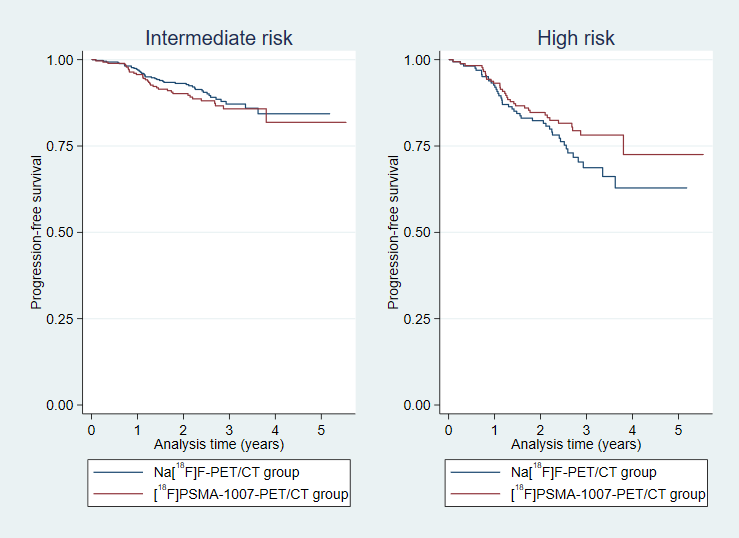
Staging with [18F]PSMA-1007-PET/ceCT affected disease stage and treatment allocation compared with Na[18F]F-PET/CT in newly diagnosed PCa. Although PFS did not differ significantly between groups, a late-emerging trend suggested a potential long-term benefit for high-risk patients staged with [18F]PSMA-1007-PET/ceCT.